

High Voltage Electrical Service for Commercial and Industrial Facilities in Jacksonville
Vanguard Electrical Contractors delivers high voltage electrical service for commercial, industrial, and government facilities throughout Jacksonville, FL, including medium voltage distribution, HV terminations, substation maintenance, and equipment testing. Licensed since 2007 (Florida EC13013821), the firm specializes in power systems above 600V serving data centers, manufacturing plants, healthcare campuses, and critical infrastructure.
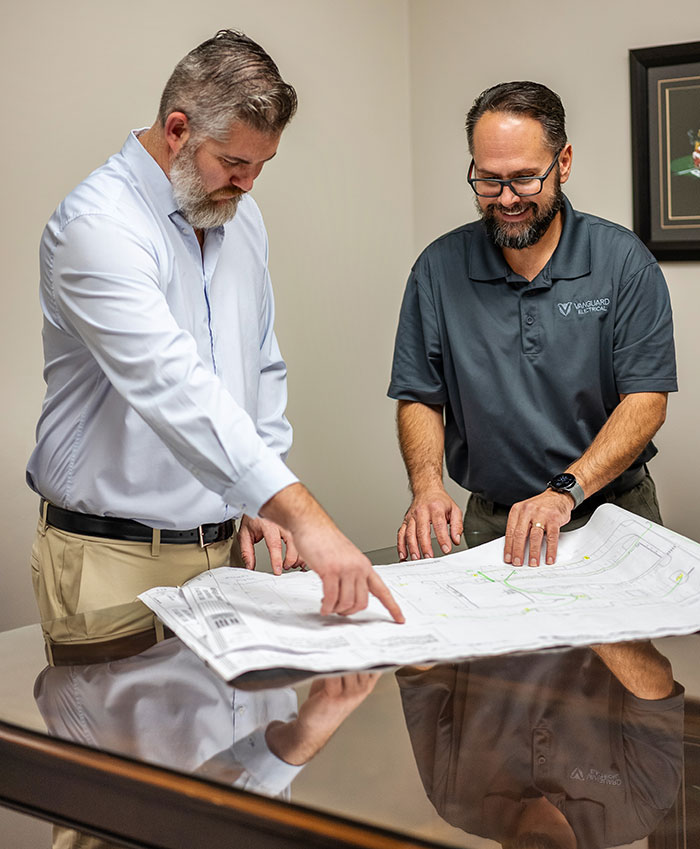
Vanguard Electrical Contractors provides high voltage electrical service for commercial, industrial, and government facilities in Jacksonville, FL — specializing in medium voltage distribution, HV terminations, substation maintenance, transformer testing, and equipment commissioning for critical power systems above 600V.
Written by The Vanguard Team — Licensed Commercial Electrical Contractors, Jacksonville, FL | Florida License EC13013821 | Serving Jacksonville Since 2007 | Led by Master Electrician Carey Frick, PMP Certified.
What Is High Voltage Electrical Service?
High voltage electrical service encompasses the installation, maintenance, testing, and repair of power systems operating above 600 volts, typically ranging from 2.4kV to 35kV in commercial and industrial settings. The National Electrical Code (NEC) Article 490 defines high voltage as nominal voltage exceeding 1000V for general use, though IEEE and OSHA standards commonly categorize systems above 600V as requiring specialized safety protocols, equipment, and contractor licensing.[1] Medium voltage (typically 2.4kV to 35kV) serves as the primary distribution voltage for large facilities, connecting utility substations to on-site transformers that step power down for end-use equipment.[2]
High voltage work requires specialized training in arc flash hazards, NFPA 70E compliance, and lockout-tagout procedures. In Florida, contractors performing HV installations must hold an EC (Electrical Contractor) license and maintain liability insurance meeting utility and facility owner requirements.[3] Vanguard Electrical holds Florida license EC13013821 and employs master electricians trained in HV safety protocols, equipment testing standards (IEEE, NETA), and utility coordination for Jacksonville-area projects.
Which Jacksonville Facilities Require High Voltage Service?
Data centers, manufacturing plants, healthcare campuses, universities, government installations, and large commercial complexes rely on high voltage electrical service to meet power demands exceeding typical low-voltage infrastructure capacity. JEA, Jacksonville’s municipal utility, delivers power at transmission voltages (69kV to 230kV) to major substations, then distributes at medium voltage (12.47kV and 4.16kV) to customer facilities equipped with on-site transformers.[4]
Facilities requiring loads above 500kW typically receive utility service at medium voltage to reduce conductor size, voltage drop, and distribution losses. A 2MW data center receiving 480V service would require conductors roughly four times larger than the same load served at 12.47kV.[2] Medium voltage distribution also enables redundant utility feeds (dual services, loop feeds) critical for mission-critical operations.
Common Jacksonville high voltage applications include:
- Data centers and colocation facilities requiring N+1 or 2N redundancy
- Manufacturing plants with large motor loads (chillers, compressors, process equipment)
- Healthcare campuses with emergency power requirements per NEC Article 517
- University research facilities and laboratory buildings
- Naval Air Station Jacksonville and other military installations
- Cold storage warehouses and food processing plants
What Services Does High Voltage Work Include?
High voltage electrical service encompasses substation maintenance, medium voltage cable installation and termination, transformer testing, switchgear commissioning, protective relay programming, arc flash studies, and equipment infrared thermography. These services ensure safe, reliable operation of power distribution systems critical to facility uptime and personnel safety.
Substation Maintenance and Testing
Substations house transformers, circuit breakers, protective relays, and metering equipment that step utility voltage down to facility distribution levels. Regular maintenance includes oil sampling and dielectric testing of transformers, contact resistance measurement of circuit breakers, and time-current coordination testing of protective relays per NETA standards.[5] Florida’s humid climate accelerates insulation degradation, making routine testing essential for preventing unexpected failures.
Medium Voltage Cable Installation
Installing MV cable (typically 5kV, 15kV, or 25kV class) requires specialized tooling, cable preparation techniques, and testing protocols. NEC Article 328 mandates shielded cable for systems above 2kV, with proper grounding of cable shields to prevent induced voltages.[1] After installation, cables undergo hi-pot testing and partial discharge testing to verify insulation integrity before energization.
Switchgear Commissioning and Arc Flash Studies
New or upgraded switchgear requires comprehensive commissioning: contact alignment, insulation resistance testing, protective relay settings verification, and integration with building management systems. Arc flash hazard analysis per NFPA 70E calculates incident energy levels at equipment locations, determining required PPE levels and equipment labeling.[6] Vanguard performs IEEE 1584 arc flash studies and applies compliant labeling for Jacksonville facilities.
| Service Category | Typical Applications | Standards / Codes |
|---|---|---|
| Substation Equipment | Transformers, breakers, switchgear | IEEE C57, NETA ATS |
| Cable Systems | MV cable, terminations, splices | NEC 328, IEEE 404 |
| Protective Systems | Relays, metering, SCADA | IEEE C37, IEC 61850 |
| Safety / Compliance | Arc flash studies, labeling, PPE | NFPA 70E, IEEE 1584 |
| Testing / Commissioning | Hi-pot, relay coordination, IR scans | NETA MTS, ANSI/NFPA 70B |
How Does Medium Voltage Differ from High Voltage?
Medium voltage typically refers to distribution systems between 1kV and 35kV, while high voltage describes transmission systems above 35kV; however, industry usage often treats “high voltage” and “medium voltage” interchangeably for commercial systems above 600V. IEEE Standard 1019 defines medium voltage as 1kV to 100kV and high voltage as 100kV to 230kV, but the NEC and OSHA use 600V as the practical threshold requiring enhanced safety protocols.[2]
For commercial contractors in Jacksonville, the distinction matters less than the regulatory and safety requirements: work on any system above 600V demands specialized training, arc-rated PPE, and compliance with NFPA 70E. Most commercial facilities receive utility service at 12.47kV or 4.16kV — voltages the industry commonly calls “medium voltage” but which require all the safety protocols of high voltage work. Vanguard’s team maintains certifications and equipment for systems up to 35kV, covering the full range of commercial and industrial distribution voltages in Northeast Florida.
What Are the Safety Requirements for High Voltage Work?
OSHA 1910.269 and NFPA 70E mandate qualified worker training, arc flash hazard assessments, appropriate PPE (including arc-rated clothing and voltage-rated gloves), energized electrical work permits, and job briefings before any work on systems above 600V. Florida statute 489.511 requires that only licensed electricians perform high voltage installations, and that contractors maintain $300,000 general liability coverage for work above 600V.[3]
Arc flash incidents represent the primary injury mechanism in HV electrical work. An arc flash at 12.47kV can release temperatures exceeding 35,000°F and blast pressures above 2,000 pounds per square foot, causing severe burns, hearing loss, and blast trauma.[6] NFPA 70E Article 130 establishes approach boundaries (limited, restricted, prohibited) and PPE categories based on incident energy calculations. For a typical 12.47kV switchgear bus, the arc flash boundary often exceeds 10 feet, requiring Category 4 PPE (40 cal/cm² rating) for certain tasks.
Vanguard maintains NFPA 70E compliance through annual safety training, documented electrical safety program procedures, and arc flash studies performed by certified engineers. Our technicians use voltage-rated test equipment, insulated tools rated for the working voltage, and approach/boundary awareness protocols on every Jacksonville project.
If your facility requires high voltage installation, maintenance, or emergency service, call Vanguard Electrical Contractors at (904) 232-4018 or request a free estimate at vanguardelectricalcontractors.com/contact-us/ to discuss your power distribution needs with our licensed team.
How Often Does High Voltage Equipment Require Maintenance?
NFPA 70B recommends annual infrared thermography, three-year transformer oil analysis, and five-year comprehensive testing of circuit breakers and protective relays for commercial medium voltage systems. The standard emphasizes condition-based maintenance informed by operational history, environmental factors, and equipment criticality.[7] Facilities in coastal Jacksonville environments face accelerated corrosion and insulation degradation, often justifying more frequent inspections.
Infrared thermography detects loose connections, overloaded circuits, and failing components before they cause outages. A hot termination identified during routine scanning can be addressed during planned maintenance rather than forcing an emergency shutdown. Transformer oil testing (dissolved gas analysis) reveals internal faults — arcing, overheating, insulation breakdown — months before catastrophic failure.[5] Protective relay testing verifies that overcurrent, differential, and ground fault protection will operate correctly during system faults, preventing equipment damage and ensuring personnel safety.
Vanguard offers maintenance agreements tailored to facility uptime requirements, coordinating testing during scheduled outages and providing detailed reports documenting equipment condition and remaining service life. Our NETA-trained technicians use calibrated test equipment traceable to NIST standards, ensuring accurate measurements and defensible documentation for insurance and regulatory compliance.
Frequently Asked Questions
What voltage is considered high voltage in commercial buildings?
Systems above 600 volts are classified as high voltage under NEC and OSHA standards, requiring specialized contractor licensing, safety protocols, and PPE. Most commercial facilities in Jacksonville receive utility service at 12.47kV or 4.16kV, stepped down through on-site transformers to 480V or 208V for distribution.
Can high voltage work be performed on energized equipment?
NFPA 70E permits energized work only when de-energization creates greater hazards or is infeasible, and requires an energized electrical work permit, qualified workers, appropriate PPE, and a documented job briefing. Vanguard follows NFPA 70E procedures and typically de-energizes equipment for installation and major maintenance, working energized only for diagnostic testing and emergency repairs.
How long does high voltage substation maintenance take?
Routine annual inspections (infrared scanning, visual inspection, relay testing) typically require 4-8 hours per substation. Comprehensive testing including transformer oil analysis, breaker timing tests, and cable hi-pot testing may require 1-3 days depending on equipment quantity and outage windows.
What is the difference between primary and secondary voltage?
Primary voltage refers to the medium voltage utility service (typically 4.16kV to 34.5kV in Jacksonville), while secondary voltage is the stepped-down voltage (usually 480V or 208V) distributed to end-use equipment. Transformers convert primary to secondary voltage within facility substations.
Do arc flash studies need to be updated regularly?
NFPA 70E recommends updating arc flash studies every five years or whenever major electrical system changes occur (added equipment, modified protective device settings, new utility service). Changes in available fault current or system configuration can significantly alter incident energy levels and required PPE categories.
For high voltage installations, substation maintenance, or emergency service in Jacksonville, contact Vanguard Electrical Contractors at (904) 232-4018 or visit vanguardelectricalcontractors.com/contact-us/ to schedule a consultation with our licensed team.
Written by The Vanguard Team — Licensed Commercial Electrical Contractors, Jacksonville, FL | Florida License EC13013821. Updated January 2026.
References
- National Fire Protection Association. NFPA 70: National Electrical Code, Article 490. https://www.nfpa.org/codes-and-standards/all-codes-and-standards/list-of-codes-and-standards/detail?code=70
- Institute of Electrical and Electronics Engineers. IEEE Std 1019: Recommended Practice for Specifying Electric Submersible Pump Cable. https://standards.ieee.org/
- Florida Department of Business and Professional Regulation. Florida Statutes Chapter 489: Contracting. https://www.flrules.org/gateway/statute.asp?id=489.511
- JEA (Jacksonville Electric Authority). Electric Service Standards and Requirements. https://www.jea.com/
- InterNational Electrical Testing Association. ANSI/NETA ATS: Standard for Acceptance Testing Specifications. https://www.netaworld.org/standards
- National Fire Protection Association. NFPA 70E: Standard for Electrical Safety in the Workplace. https://www.nfpa.org/codes-and-standards/all-codes-and-standards/list-of-codes-and-standards/detail?code=70E
- National Fire Protection Association. ANSI/NFPA 70B: Recommended Practice for Electrical Equipment Maintenance. https://www.nfpa.org/codes-and-standards/all-codes-and-standards/list-of-codes-and-standards/detail?code=70B